
Stardust is one of the most precious resources in Pokémon GO — you need it constantly for powering up and unlocking moves, yet it drains away fast. So in this guide we rank the "Stardust-bonus" Pokémon — the ones that hand you extra Stardust on catch — not just by raw Stardust, but by expected value: Stardust amount multiplied by catch rate. A Pokémon that gives a lot of dust but is hard to catch isn't actually efficient, so more dust doesn't always mean more value.
By the end you'll know which Pokémon are genuinely worth catching to build up your Stardust bank — from the ones that give plenty of dust yet stall on value, to the everyday favorites you can farm with ease. We count them down from the bottom in an expected-value ranking.
Looking for full stats, moves, and ratings? We run a database-style Pokémon GO site:
Pokémon GO Database (Pokégogo)
Stardust Amount Ranking (All 24)
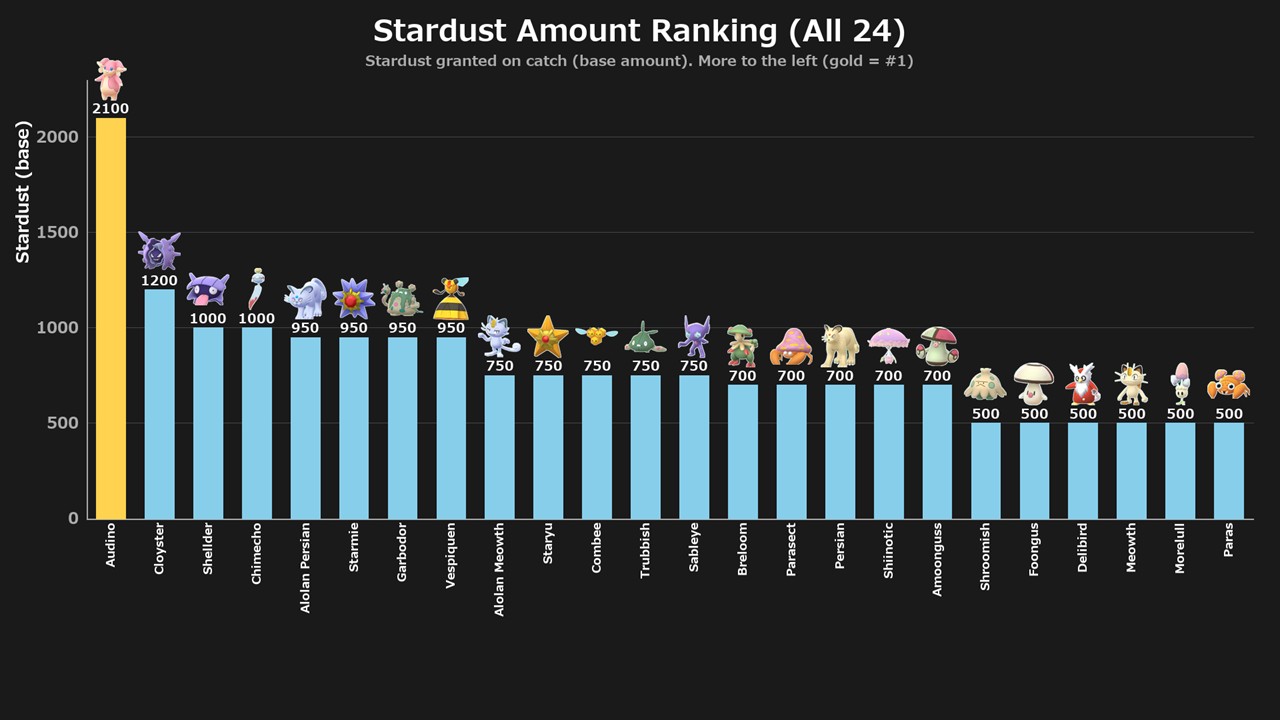
First, ignoring catch rate, here is every Stardust-bonus Pokémon ranked by the raw Stardust you get on catch. Top of the list is  Audino at 2,100, then
  Cloyster at 1,200, followed by
  Shellder and
  Chimecho tied at 1,000.
Here is a neat detail: evolved Pokémon get a +200 Stardust bonus. Cloyster, at #2, is the evolved form of Shellder at #3 — that is exactly Shellder's 1,000 plus a 200 evolution bonus, giving 1,200. So this all-24 list mixes in evolved forms you rarely meet in the wild, and remember, it is still just the raw Stardust amount — catch difficulty is not in the picture yet.
Easy-to-Catch in the Wild (14)
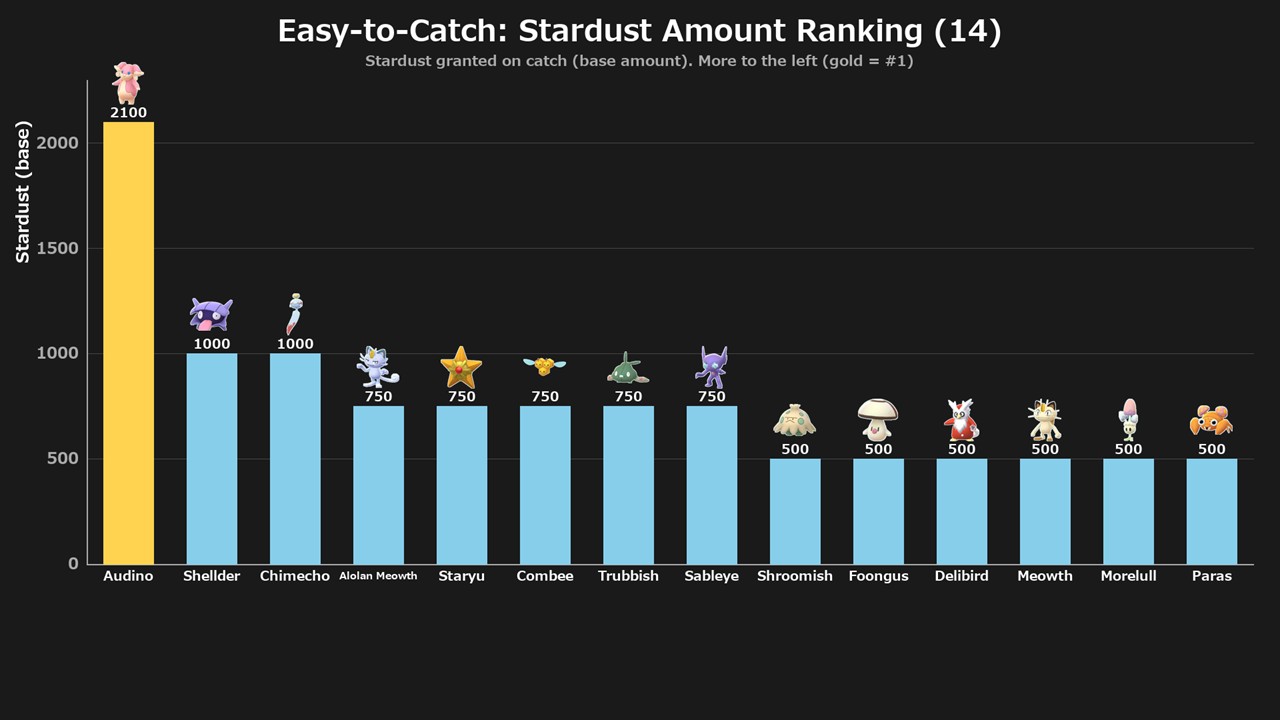
Drop the evolved forms and other hard-to-find Pokémon, and you are left with 14 you can realistically catch in the wild. Audino still tops it at 2,100, with Shellder and Chimecho behind at 1,000. But the Pokémon that give the most dust tend to be the hardest to catch, so raw amount alone cannot tell you what is truly worth your time. From here we re-rank these 14 by expected Stardust, with catch rate factored in.
Catch Rate and the Map
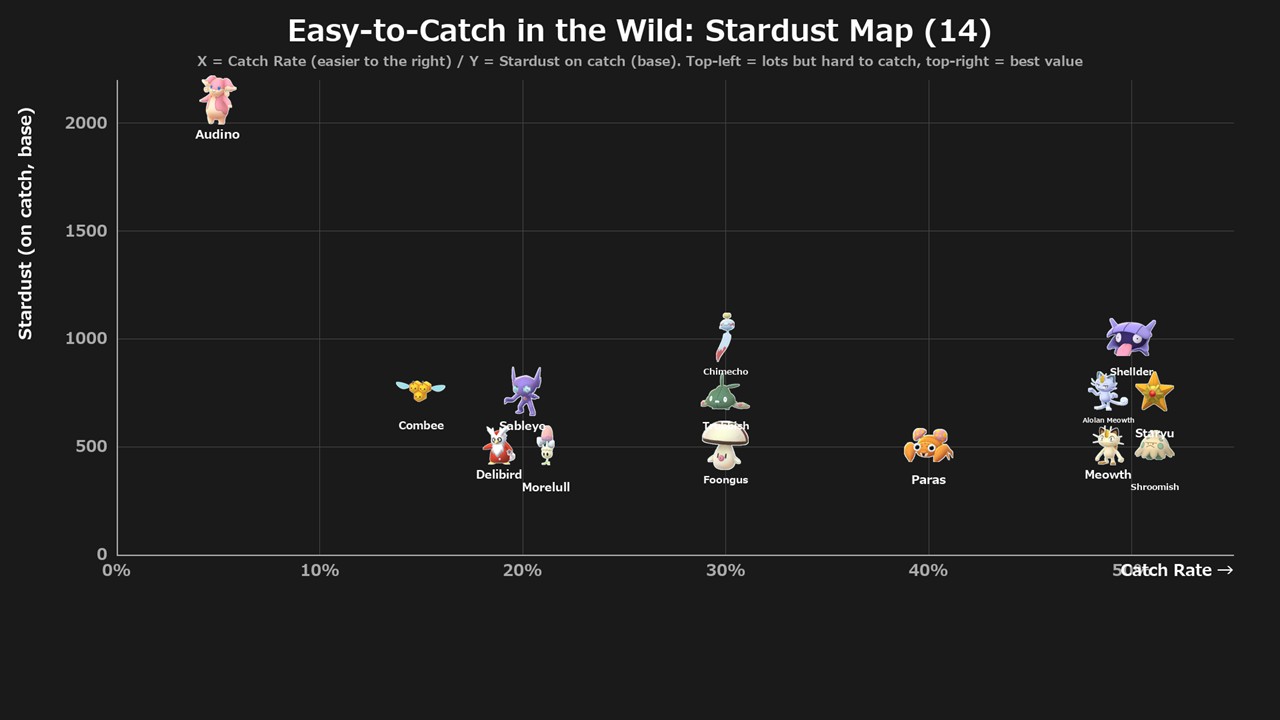
The piece that matters most for efficiency is catch rate. A Pokémon can look generous on paper, but if it keeps fleeing, the dust you actually pocket drops sharply. Plotting catch rate on the X-axis and Stardust on the Y-axis, the top-right corner (easy to catch and lots of dust) is the sweet spot, while the top-left (lots of dust but hard to catch) is a deceptively poor-value zone. Next we turn that "top-right is best" feel into a single number.
How Expected Stardust Works (Dust × Catch Rate)
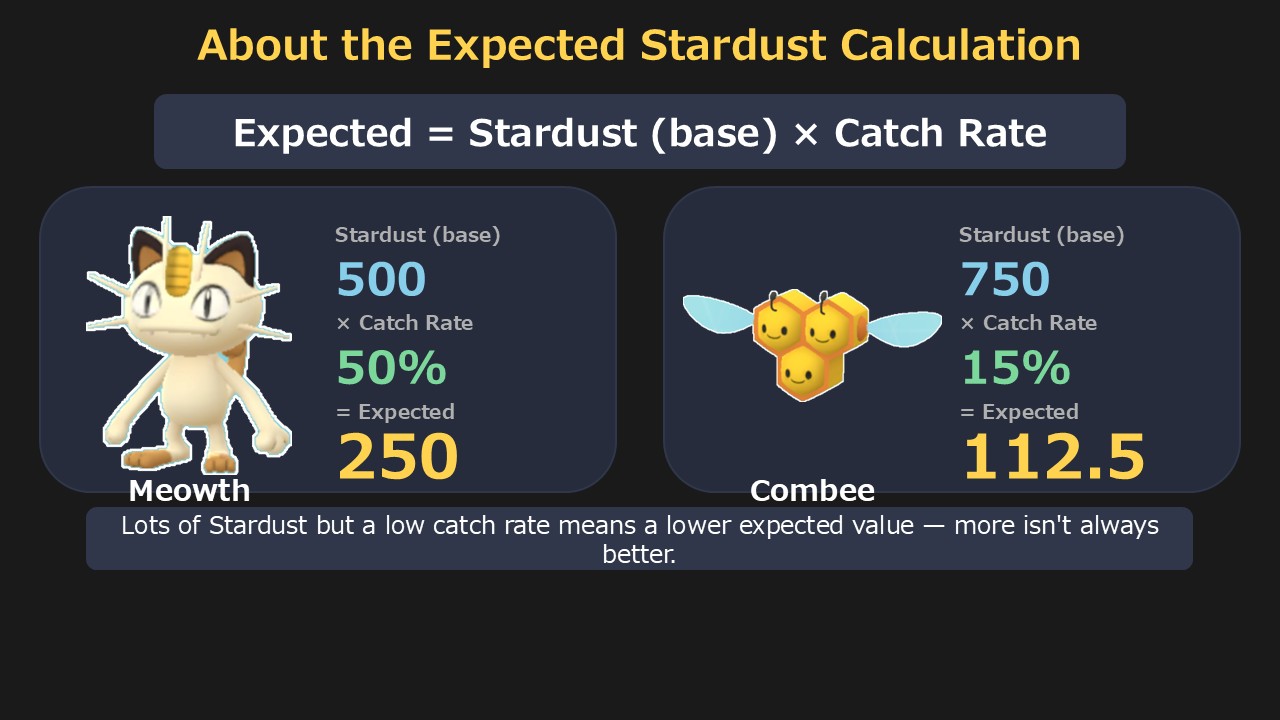
Expected Stardust is simply the base Stardust multiplied by the catch rate. For example,  Meowth gives 500 dust at a 50% catch rate, so its expected value is 250.
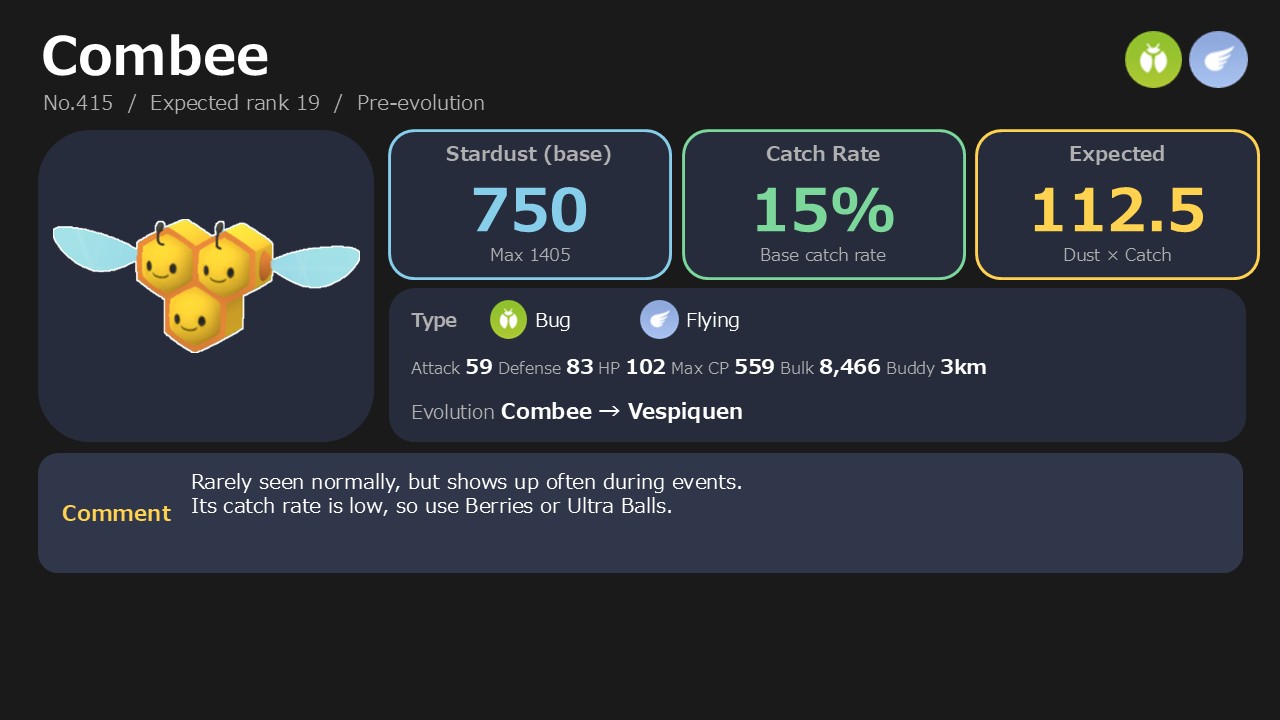
  Combee, on the other hand, gives a bigger 750 dust but only a 15% catch rate — multiply it out and you get 112.5, which means the lower-dust Meowth actually wins on expected value. A high dust number with a low catch rate sinks the expected value fast, and that is the single most important idea in this whole ranking.
Since evolved Pokémon carry that +200 bonus, we focus on the 14 wild-catchable Pokémon here, and count the expected-value ranking down from the bottom.
Expected-Value Ranking: #14–#11 (Combee)
Last place at #14 is  Morelull with an expected value of 100 (500 dust at a 20% catch rate). Right alongside it is
  Delibird, also at 100. Even the bottom of this list is about five times an ordinary Pokémon, so the Stardust-bonus pool runs deep.
#11 is Combee at 112.5. It gives a healthy 750 dust, but even a Golden Razz Berry plus an Ultra Ball will not stop it from fleeing — its catch rate is so low that its value stalls. A headliner in the "lots of dust" conversation, yet a bittersweet pick once efficiency comes into it.
#10–#8 (Paras)
#10 is  Sableye at 150, tied at #9 with
  Foongus, also 150 (500 dust at 30%).
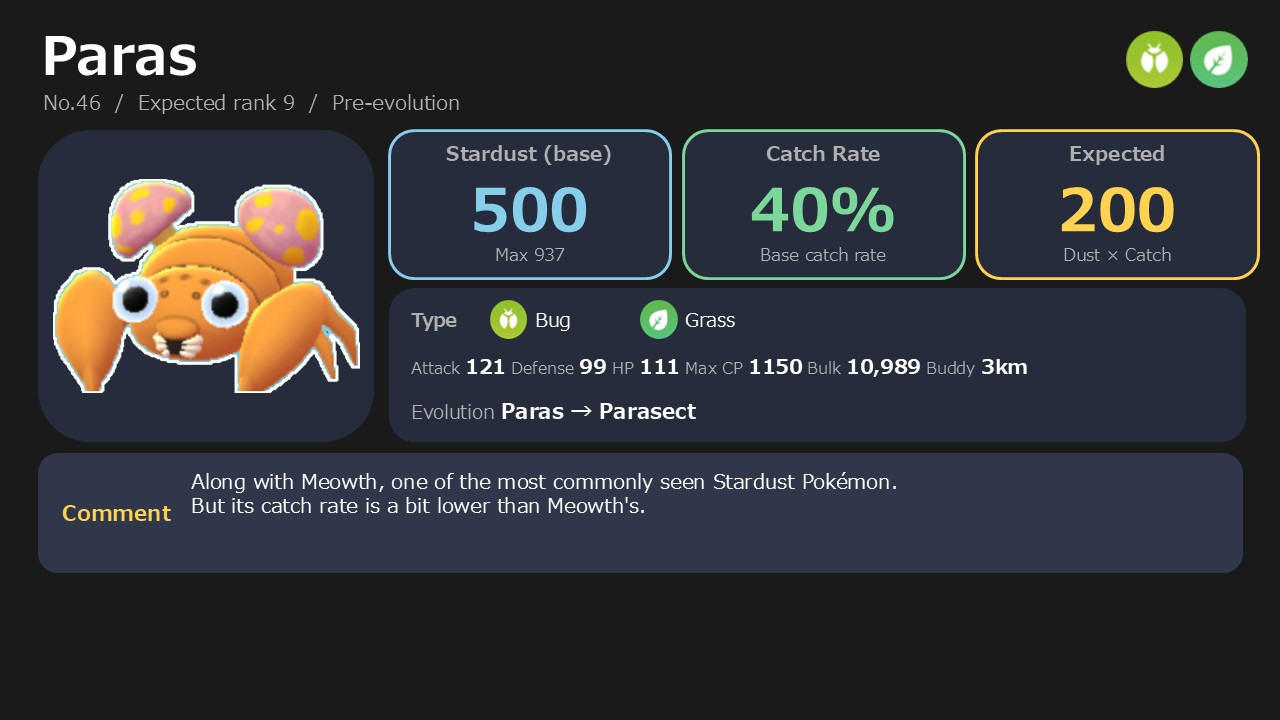
#8 is  Paras with an expected value of 200 (500 dust at 40%). Its biggest selling point is that you see it out in the field all the time, even outside events. Its catch rate is a touch below the very top tier, but it is a friendly, easy everyday Stardust target.
#7–#6 (Meowth)
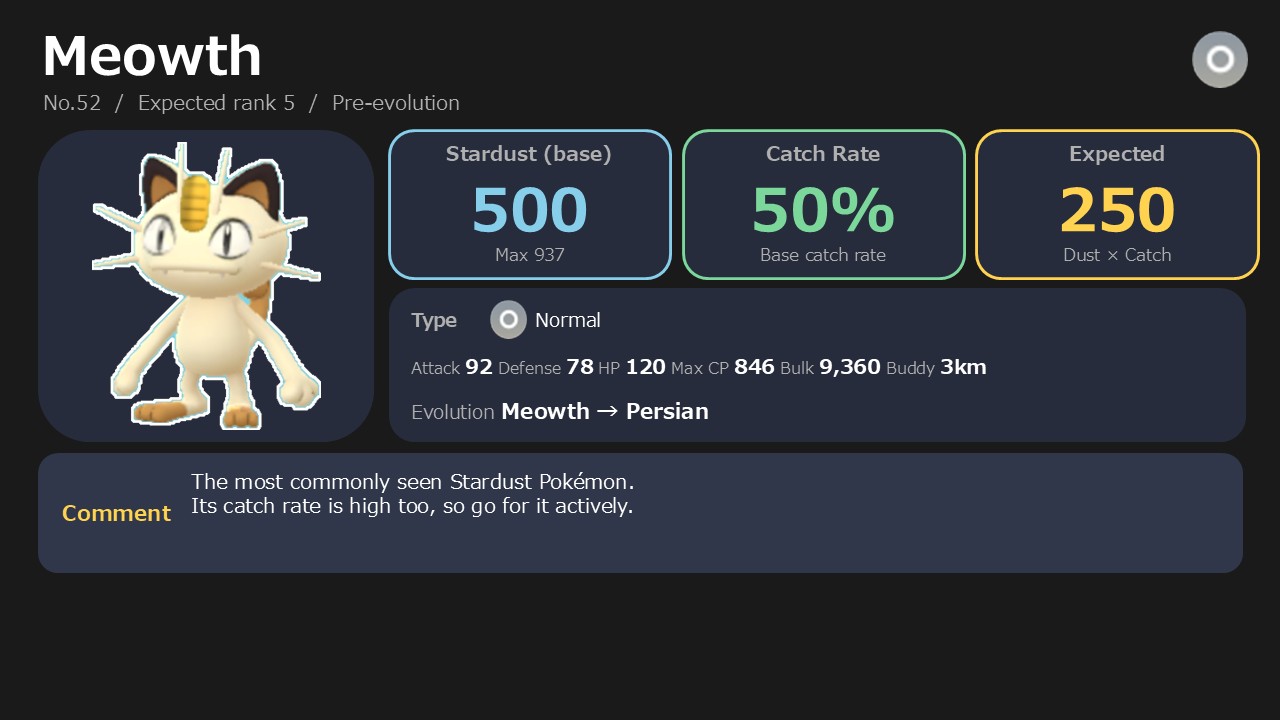
#7 is  Trubbish at 225 (750 dust at 30%). And #6 is Meowth, with an expected value of 250 (500 dust at 50%). It is the Stardust-bonus Pokémon you will bump into most often, its catch rate is high, and it is genuinely one to go after. Note that Alolan Meowth is a Stardust-bonus Pokémon too, but Galarian Meowth is — for whatever reason — not on the list.
#5–#4 (Shroomish & Chimecho)
Tied at #5 is  Shroomish with an expected value of 250 (500 dust at 50%) — the same number as Meowth, and just as recommendable.
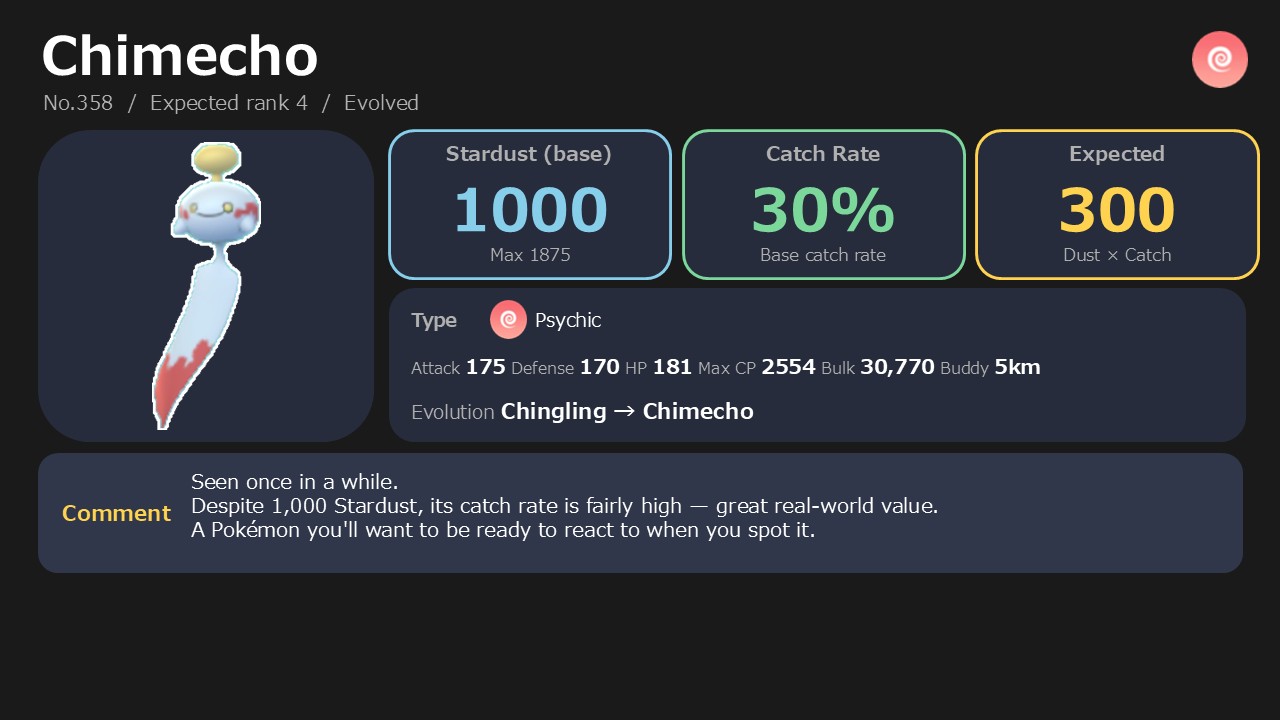
#4 is Chimecho at 300 (1,000 dust at 30%). For a 1,000-dust Pokémon its catch rate is not bad at all, which makes its real-world value top-class. You will not see it often, but when you do, catch it without fail.
#3–#2 (Staryu & Alolan Meowth)
#3 is  Staryu and #2 is
  Alolan Meowth, both with an expected value of 375 (750 dust at 50%). That is better value than Meowth, but you will really only see them during events, so everyday encounters are rare. If you spot one, tap and catch it on sight.
#1 Shellder (Expected Value 500)
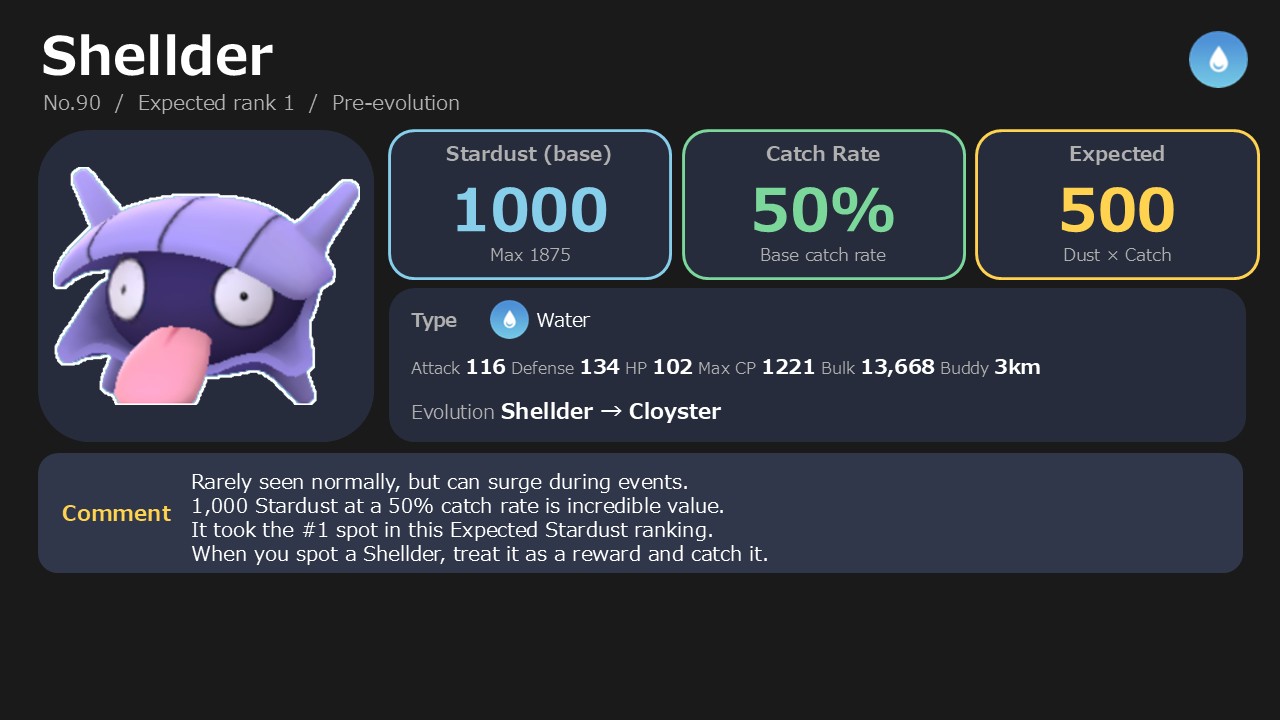
Taking the crown is Shellder. At 1,000 dust and a 50% catch rate, its expected value is a remarkable 500. Maybe because letting it show up daily would be too good, you do not see it often — but it has been featured in Spotlight Hours, and stacking Star Pieces and other bonuses on top makes for the best Stardust-farming window there is. The moment you spot one, react first and catch it.
Bonus: Audino — Most Dust, Worst Value
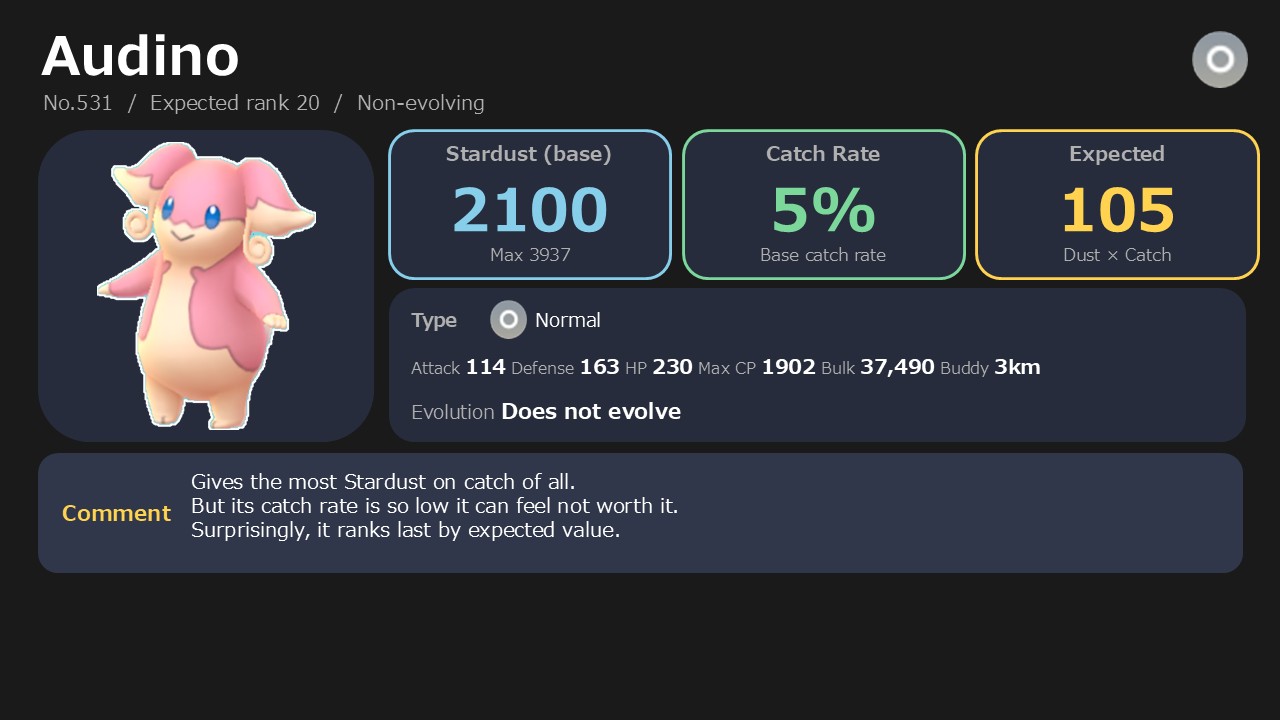
One bonus note to finish. Remember Audino, the runaway #1 on the raw Stardust ranking at the start? Its 2,100 dust is the most of any Pokémon — and yet by expected value it sinks to the bottom group. Its catch rate is just 5%, which drags the expected value down to 105. It flees even when you land a Golden Razz Berry plus an Excellent curveball with an Ultra Ball, so as surprising as it looks, the result feels fair in practice. It is still more efficient than an ordinary Pokémon, so call it a near miss — and the textbook example that "more dust" does not always mean "better value."
The Full Ranking (14)
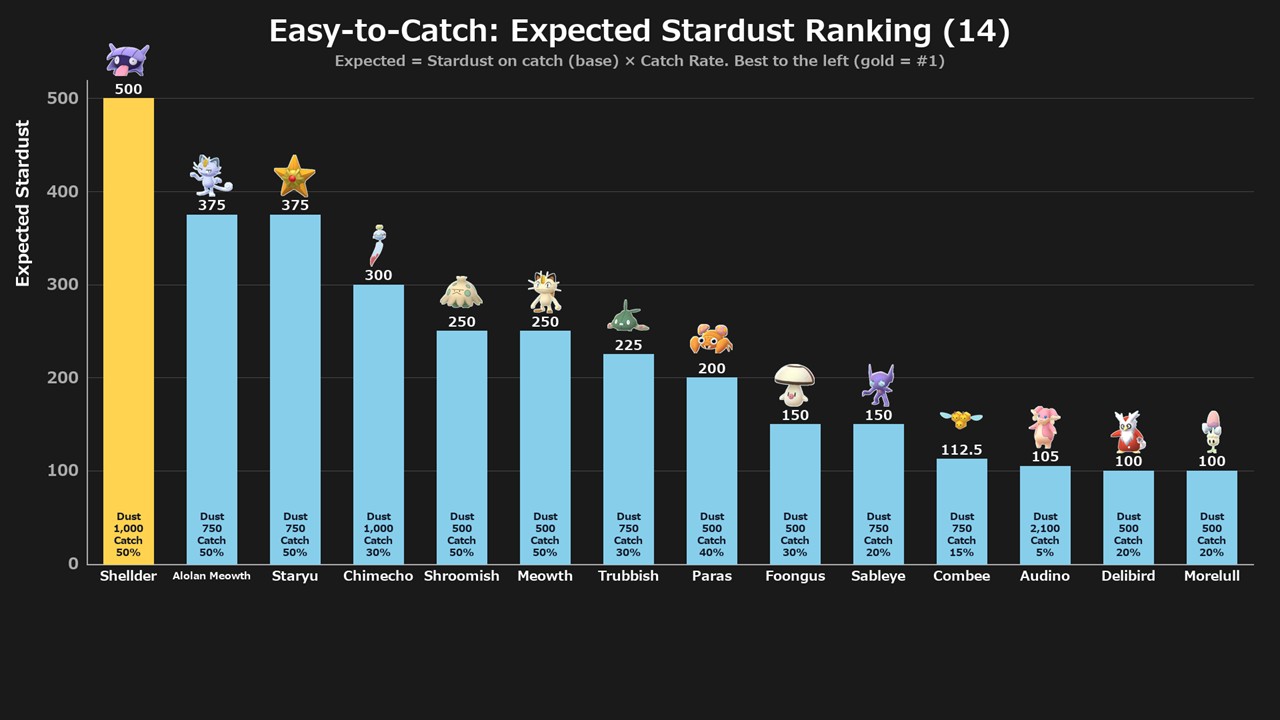
Here are all 14 wild-catchable Pokémon lined up by expected Stardust. #1 Shellder at 500, #2 Alolan Meowth and #3 Staryu at 375, #4 Chimecho at 300, and on down — with Combee at 112.5 and Audino at 105 sitting near the bottom. The Pokémon that give plenty of dust but will not be caught do sink, and it is clear at a glance: raw Stardust alone does not win.
Summary: Stardust-Efficiency Top 5
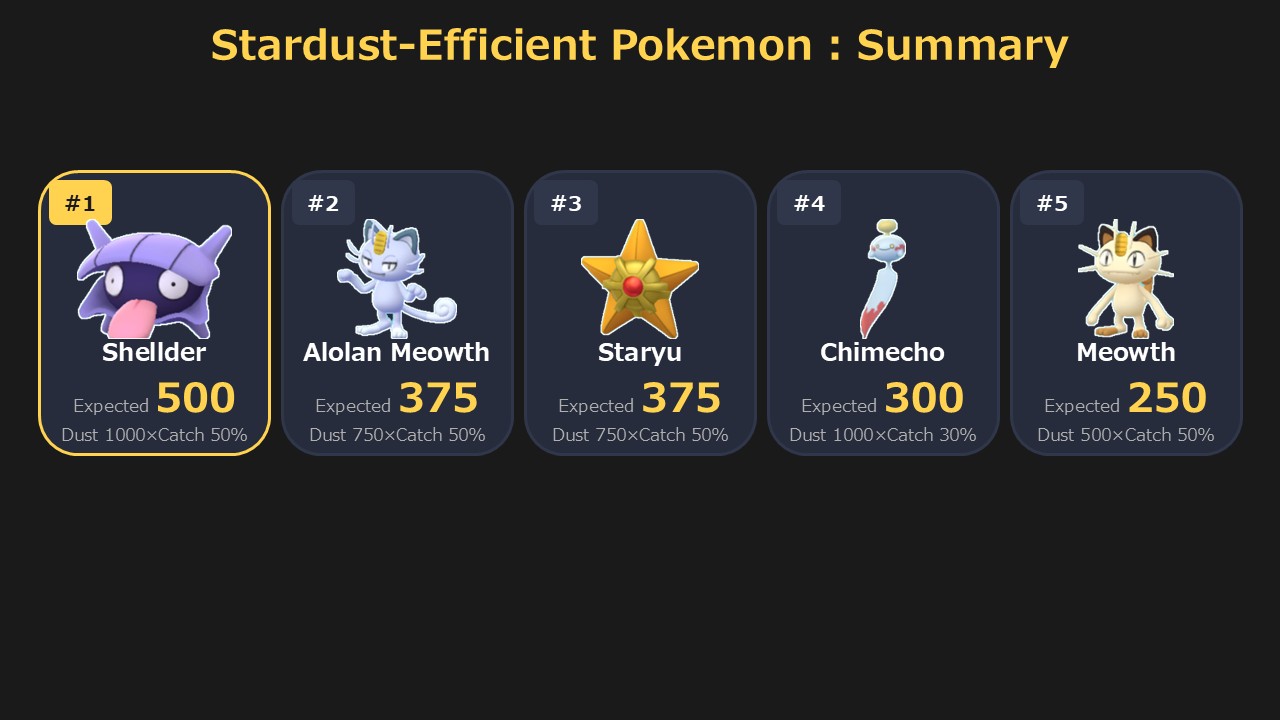
The most Stardust-efficient picks by expected value are:
#1 Shellder (expected 500)
#2 Alolan Meowth (expected 375)
#3 Staryu (expected 375)
#4 Chimecho (expected 300)
#5 Meowth (expected 250)
Even when the field is so crowded you feel like "ugh, too many," just catching the efficient Stardust-bonus Pokémon like Meowth and Paras is enough — keep it up and your Stardust steadily piles up. Aim to always have plenty on hand when you need it, and farm it efficiently.
Related links
Individual evaluation pages for the Stardust-bonus Pokémon featured here:
Pokémon GO database:
